MIIETF has more than doubled your money since launch. The catch? Its own benchmark did even better and the gap is widening.
Let's cut straight to it.
MIIETF the Mahaana Islamic Index Exchange Traded Fund, is Pakistan's most accessible halal equity investment. One ticker. Thirty Shariah-screened stocks. Instant exposure to Pakistan's biggest Islamic companies, traded on the PSX like any share you already own.
Since launch on 11 March 2024, it has returned 104.95%. That's not a typo. It has literally more than doubled investor capital in just over two years.
But here's what the fund brochure won't tell you: the benchmark it was designed to track returned 116.79% over the same period. That's a nearly 12 percentage point gap and it exists across every single time horizon we measured.
This review doesn't sugarcoat that. Instead, it explains why the gap exists, whether it's structural or fixable, what you actually own inside this fund, and most importantly whether MIIETF deserves a spot in your long-term halal portfolio in 2026.
What is Meezan Islamic Index ETF?
MIIETF is the Mahaana Islamic Index Exchange Traded Fund, a Shariah-compliant ETF listed on the Pakistan Stock Exchange. Managed by Mahaana Wealth Limited, it tracks the Mahaana Islamic Index (MII30) consisting of the top 30 free-float weighted Islamic stocks on the PSX, filtered for minimum liquidity.
As of 14 May 2026: iNAV at PKR 16.6739, net assets of PKR 1,761.3 million.
Think of it this way: instead of spending weeks vetting 30 individual halal stocks, rebalancing every quarter, and watching your emotions during drawdowns, you buy one ticker and you're done. You get Fauji Fertilizer, Engro Holdings, Meezan Bank, Hub Power, OGDC, Lucky Cement and 24 other large-cap Shariah-compliant names in a single trade.
For most Pakistani retail investors, that's genuinely revolutionary access. No fund manager meetings. No minimum deposits. Just your broker app and a buy order.
MIIETF Performance vs Benchmark: A Closer Look at Returns
Let's start with the good news, because there is plenty of it.
- +24.99% year-to-date (as of 14 May 2026)
- +28.24% over the last 12 months
- +104.95% since inception, more than doubling from PKR 10 at launch
In Pakistan's investment landscape, where most people park their savings in bank accounts earning single-digit returns, those numbers are exceptional.
Now here's the uncomfortable part.
A passive ETF isn't judged on whether it went up, it's judged on whether it delivered what it promised. And on that metric, MIIETF has consistently underdelivered. Across every time horizon, the benchmark beat the fund:
| Period | MIIETF | MII30 Benchmark | KMI30 | Gap vs Benchmark |
|---|---|---|---|---|
| MTD | 2.16% | 2.80% | 2.67% | -0.64% |
| YTD | 24.99% | 27.20% | 29.99% | -2.21% |
| 90 Days | -6.71% | -6.02% | -5.15% | -0.69% |
| 1 Year | 28.24% | 31.71% | 32.85% | -3.47% |
| Since Inception | 104.95% | 116.79% | 115.88% | -11.84% |
Performance data as of 14 May 2026. Source: Mahaana Wealth / PSX. Past performance is not a guarantee of future results.
That last row is the one that matters. -11.84% since inception. That's not noise. That's not rounding error. That is real money left on the table and it demands an explanation.
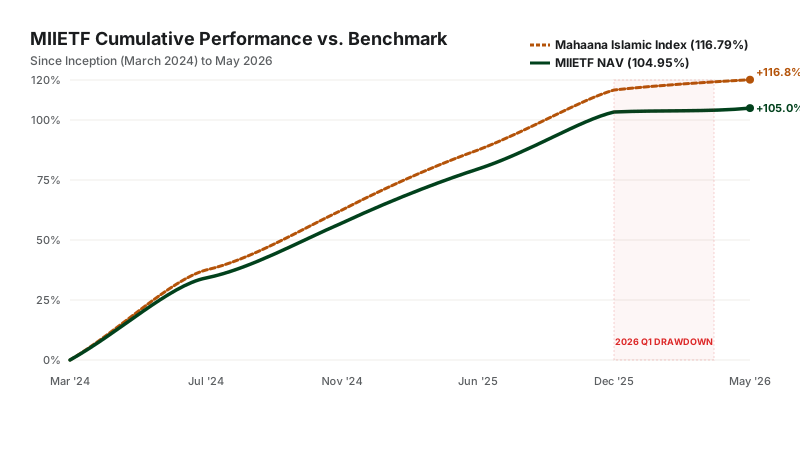
MIIETF Chart Analysis: Volatility and Tracking Error
The price chart tells a story of two phases.
Phase one: a steady climb from PKR 10 at launch, gaining momentum through late 2024 and exploding higher in 2025. By early 2026, the fund was trading near PKR 18.50-19 at its peak. Investors who bought at launch had roughly doubled their money.
Phase two: a brutal correction. Between February and April 2026, MIIETF fell from ~PKR 19 to the PKR 15 zone. That's an 18-20% drawdown in a matter of weeks. Painful, but not shocking for a high-beta Pakistani equity fund.
What is worth noting: the ETF appears to have fallen harder than its benchmark during the selloff, then recovered less efficiently. In the six months to May 2026, the benchmark was ahead by nearly four percentage points in January and that lead only grew as markets turned volatile in March.
The takeaway: MIIETF doesn't just lag in calm markets. The gap gets wider when conditions get rough. That's the opposite of what a well-structured passive vehicle should do.
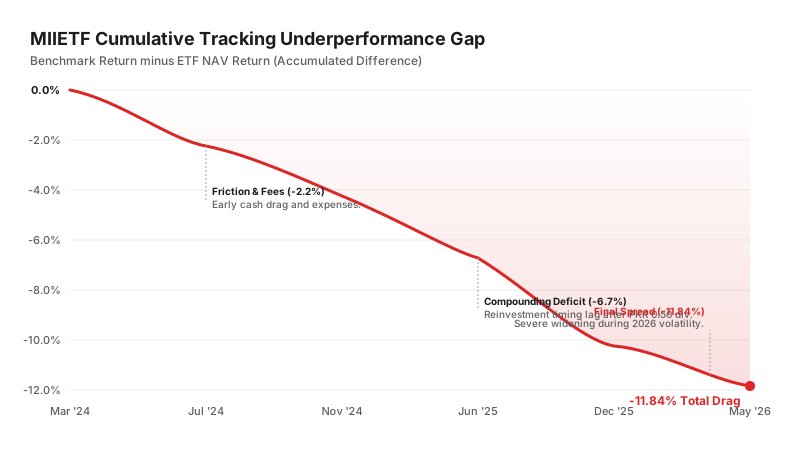
Why MIIETF Underperforms the MII30 Benchmark
Three culprits. None of them fully explain it alone.
Culprit 1: Fees
At 0.75% management fee plus government levies, MIIETF's total expense ratio runs ~1.15-1.16% per year. That's a guaranteed annual headwind. Over two years, it accounts for maybe 2-3 percentage points of the gap. Not 11.84%.
Culprit 2: Market microstructure
Every time MIIETF rebalances its 30-stock basket, it faces real-world costs: bid-ask spreads, market impact, timing differences between when dividends hit the index versus when they hit the fund. Each one is small. Together, they compound.
Culprit 3: Arbitrage failure
This is the subtle one. MIIETF's PKR 1.76 billion asset base is respectable, but still small by global ETF standards. Smaller ETFs depend more heavily on authorised participants to keep the market price aligned with NAV. When volume thins out and volatility spikes, that alignment can break down. The fund then trades at a discount to what it's actually worth and you absorb that slippage.
The result: MIIETF tracks fine when markets are quiet. It leaks performance when they're not. And that's precisely when the tracking gap matters most to your compounding.
MIIETF Portfolio Composition: Sector and Stock Concentration
Thirty stocks sounds diversified. It's not, not really.
The top 10 holdings alone represent ~74.97% of the portfolio. This is a large-cap, sector-concentrated fund wearing a diversification badge.
Here's how the concentration looks:
- Fauji Fertilizer (FFC): 15.13%
- Engro Holdings: 9.90%
- Meezan Bank: 8.14%
- Hub Power: 7.43%
- OGDC: 7.24%
- Plus Lucky Cement, PPL, Mari Energies, Systems Limited, Engro Fertilizers...
By holding 10, you've effectively covered three-quarters of the fund.
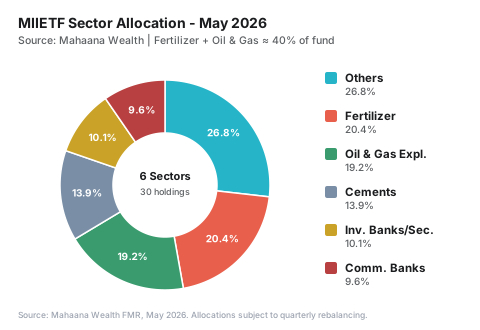
Sector-wise, it gets even more concentrated:
- Fertilizers: 20.41%
- Oil & Gas Exploration: 19.23%
- Cement: 13.86%
Nearly 40% of MIIETF rides on fertilizer and oil & gas alone. These are cyclical, commodity-sensitive sectors spectacular when macro tailwinds blow, punishing when they turn.
This is not a criticism of the fund design. It's just what an Islamic large-cap index in Pakistan looks like. The point is to own it with clear eyes: MIIETF is a cyclical, commodity-linked Pakistani equity play, not a smooth, all-weather diversifier.
MIIETF Dividend Analysis
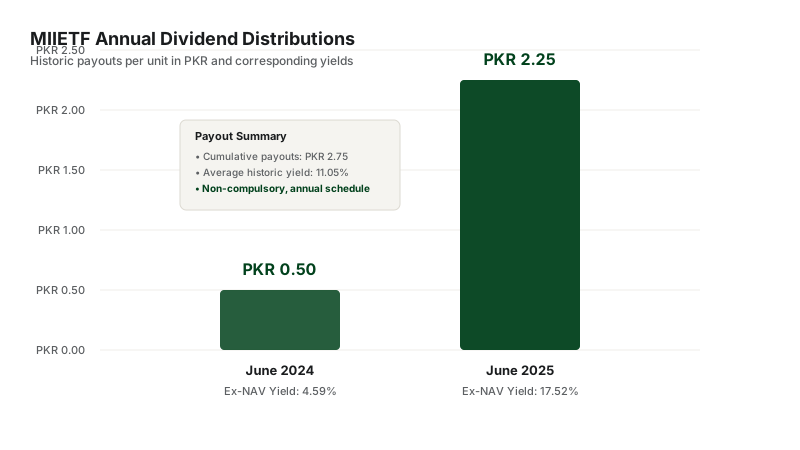
Two payouts since launch. Both meaningful.
- June 2024: PKR 0.50 per unit - a 4.59% yield on ex-NAV
- June 2025: PKR 2.25 per unit - a 17.52% yield
That second number is eyebrow-raising. Don't let it tempt you into treating MIIETF as an income fund.
It isn't. Distributions are annual and discretionary, not guaranteed. The 17.52% payout reflected exceptional market conditions and realised portfolio gains in 2025. Expecting that to repeat every year would be like budgeting for a lottery win.
The smarter framing: dividends from MIIETF are a bonus, not a strategy. The real question is whether the fund retains enough compounding power between payouts to justify the tracking friction. Based on the data so far, that's where it struggles.
MIIETF Expense Ratio (TER) and Hidden Tracking Costs
Depends entirely on your reference point.
Versus global ETFs: Expensive. US or European index funds regularly charge below 0.20% per year. At ~1.15% TER, MIIETF charges 5-6x more.
Versus Pakistan's own ETF market: Fair. Pakistan's market structure, Shariah screening overhead and smaller fund sizes all push costs up. MIIETF isn't an outlier locally.
But here's the number that should actually worry you: if your fund loses 11.84% to its benchmark over just over two years, your real cost of ownership isn't 1.15%. It's far higher. The published TER is the visible expense. The tracking gap is the invisible one and the invisible one is larger.
Think of it as a hidden tax on your compounding. Every rupee lost to slippage is a rupee that won't compound for the next 10 years.
Is MIIETF Right for Your Islamic Investment Portfolio?
This fund was built for a specific investor and if you're that investor, it's genuinely one of the best tools available to you right now in Pakistan.
MIIETF works for you if:
- You want halal equity exposure without manually vetting 30 stocks for Shariah compliance
- You're building wealth over 5+ years and can stomach 20-30% drawdowns without panic-selling
- You prefer the simplicity of ETF investing by buying on PSX, no fund manager relationship needed
- You're setting up a monthly investment plan (DCA) and want a core position to build around
- Dividends are a pleasant surprise, not your income source
MIIETF is the wrong tool if:
- You're a performance-sensitive investor who needs tight benchmark replication
- You trade tactically over weeks or months and the spread and tracking friction will eat you alive
- You're seeking a low-cost passive wrapper because at ~1.15% TER plus tracking slippage, this isn't that
How to Build a Wealth Strategy with MIIETF on the PSX
Here's the honest truth about where MIIETF belongs in a real wealth plan.
It's not a cash equivalent. It's not an income strategy. It is a high-risk, high-beta equity ETF rated 5 out of 5 on the SECP risk scale, meaning it can and does move 20% in either direction within a few weeks.
Used correctly, it functions as the core Pakistani equity sleeve inside a broader, layered portfolio. That means: emergency fund first. Then fixed-income or money market buffer. Then MIIETF as your halal equity engine, with any tactical bets placed around it, not instead of it.
On current levels near PKR 16.60: the fund is well off its early-2026 peak of PKR 19 but well above the 2025 launch base. It's not obviously cheap, nor is it obviously overpriced. The strongest case for buying now is a disciplined DCA, averaging in over 6-12 months rather than going all-in on a single day.
Patience and averaging aren't exciting strategies, they're just the right ones for an asset class this volatile.
Final Verdict: Should You Buy MIIETF in 2026?
MIIETF is a genuine achievement for Pakistan's investment market. It democratised halal equity investing for retail investors who previously had to choose between stock-picking and sitting out the market entirely.
But democratic access and flawless execution are different things, and MIIETF has not delivered the latter. The 11.84% gap since inception isn't a rounding error. It's a structural reality that compound-conscious investors need to account for.
So should you buy MIIETF?
If you're a long-term, Shariah-focused Pakistani investor building wealth through equities yes. It's the most practical vehicle you have.
If you're evaluating it against international passive standards or expecting it to faithfully mirror an index not yet. The tracking discipline needs to improve before that case holds.
Own it for what it is. A powerful access tool with real strengths, a known structural weakness, and a tracking gap you should check every six months, not ignore for a decade.
Frequently Asked Questions (FAQs)
Is MIIETF halal / Shariah compliant?
Yes. MIIETF exclusively holds securities screened under the KMI All Share Index Shariah framework and is classified as Shariah-compliant by its fund manager, Mahaana Wealth Limited. It tracks the Mahaana Islamic Index (MII30), which excludes companies involved in interest-based banking, alcohol, tobacco and other non-permissible activities.
What is the MIIETF expense ratio (TER)?
As of the latest fund manager report, the Total Expense Ratio (TER) is approximately 1.05%-1.20% per annum, which includes the 0.75% management fee plus applicable government levies. This is within the SECP regulatory cap of 2.5% for index-tracking funds.
How does MIIETF compare to the KMI-30 Index?
Over the period since inception (March 2024 to May 2026), MIIETF returned 104.95% while the KMI-30 returned 115.88%. MIIETF's own benchmark, the MII30, returned 116.79% over the same period. In practice, MIIETF has trailed both indices, primarily due to expense drag, rebalancing friction and imperfect arbitrage between market price and NAV.
Can I buy MIIETF through a regular brokerage account in Pakistan?
Yes. MIIETF is listed on the Pakistan Stock Exchange (PSX) and can be purchased through any NCCPL-registered broker the same way you would buy individual shares. You do not need a mutual fund account.
Does MIIETF pay dividends?
Yes, on a discretionary annual basis. Since launch, MIIETF has paid two distributions: PKR 0.50 per unit in June 2024 and PKR 2.25 per unit in June 2025. Distributions are not guaranteed and depend on the underlying portfolio's income and the fund manager's payout policy.
What is MIIETF's risk rating?
MIIETF carries a risk rating of 5 out of 5 (Very High Risk) as classified under SECP guidelines, reflecting its 100% equity exposure and concentration in cyclical Pakistani sectors including fertilizers, oil & gas exploration and cement.